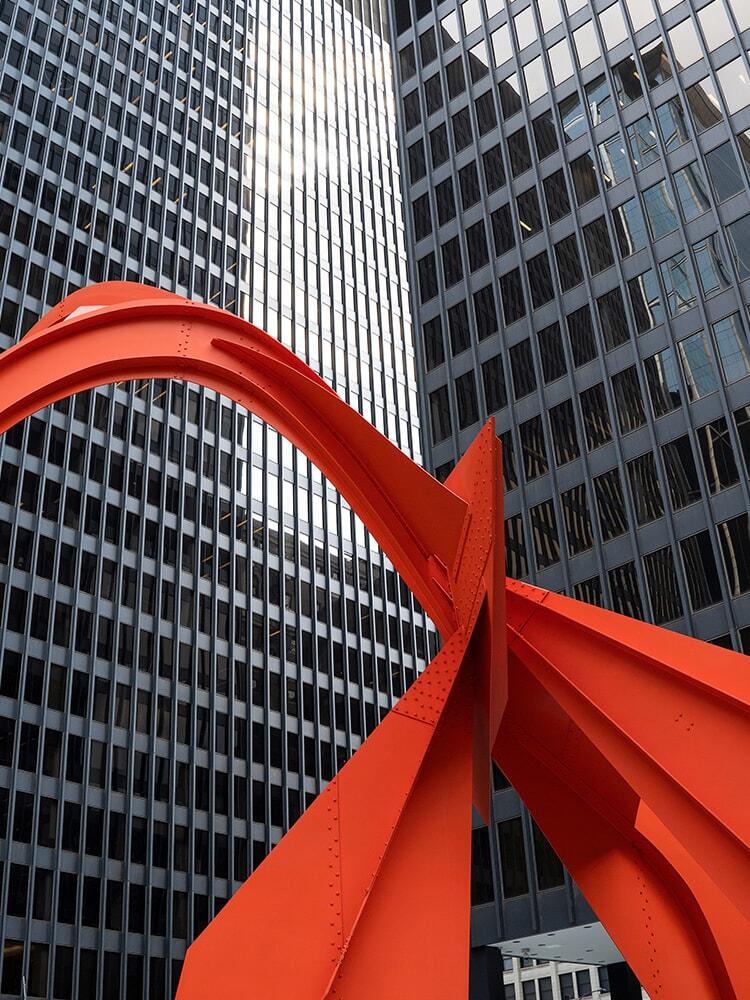
What a perfect little lens. My constant travel companion.
IMPRESSION What a perfect little lens. My constant travel companion. CONTEMPORARY 18-50mm F2.8 DC DN by Jim Koepnick Traveling to a major city is my type of vacation, giving me…
READ MORE
A large F2.8 aperture zoom lens that need never leave your camera
This exceptionally small, light and bright standard zoom
for crop-sensor mirrorless cameras is the ultimate workhorse lens.
Sigma’s first APS-C size mirrorless zoom lens has a versatile full-frame equivalent zoom range of 27-75mm, which makes it ideal for a wide range of photo and video applications including landscapes, portraits, street photography, architecture and events. It can also be used for macro-style close-up photography owing to its maximum magnification of 1:2.8*1, which allows a minimum focusing distance of just 12.1cm. In terms of its bright F2.8 aperture, it makes for easier hand-held low-light shooting and provides a shallow depth-of-field for high-impact results.
Autofocus is exceptionally fast and quiet thanks to the stepping motor, which can be particularly useful when shooting video, or fast-moving subjects such as children and animals. The lens’ exceptionally small and light form factor that weighs less than 300g makes it perfect as a first interchangeable lens, and as a sub-lens for full-frame bodies *2, as well as for various shooting situations.
*1 The minimum focusing distance and maximum magnification ratio are both values at the wide end.
*2 Please switch to APS-C crop mode when used on full-frame cameras.
| Camera Type | Mirroless |
|---|---|
| Corresponding Mount | L-Mount,Canon RF Mount,FUJIFILM X Mount,Sony E-mount |
| Sensor Format | APS-C [DC] |
| Lens Construction | 10 groups, 13 elements (1 SLD and 3 aspherical lenses) |
| Angle of View | L-Mount:76.5°(W)-31.7°(T) |
| Number of Diaphragm Blades | 7 (rounded diaphragm) |
| Minimum Aperture | F22 |
| Minimum Focusing Distance | 12.1(W)-30(T)cm / 4.8(W)-11.9(T)in. |
| Maximum Magnification Ratio | 1:2.8(W)-1:5(T) |
| Filter Size | φ55mm |
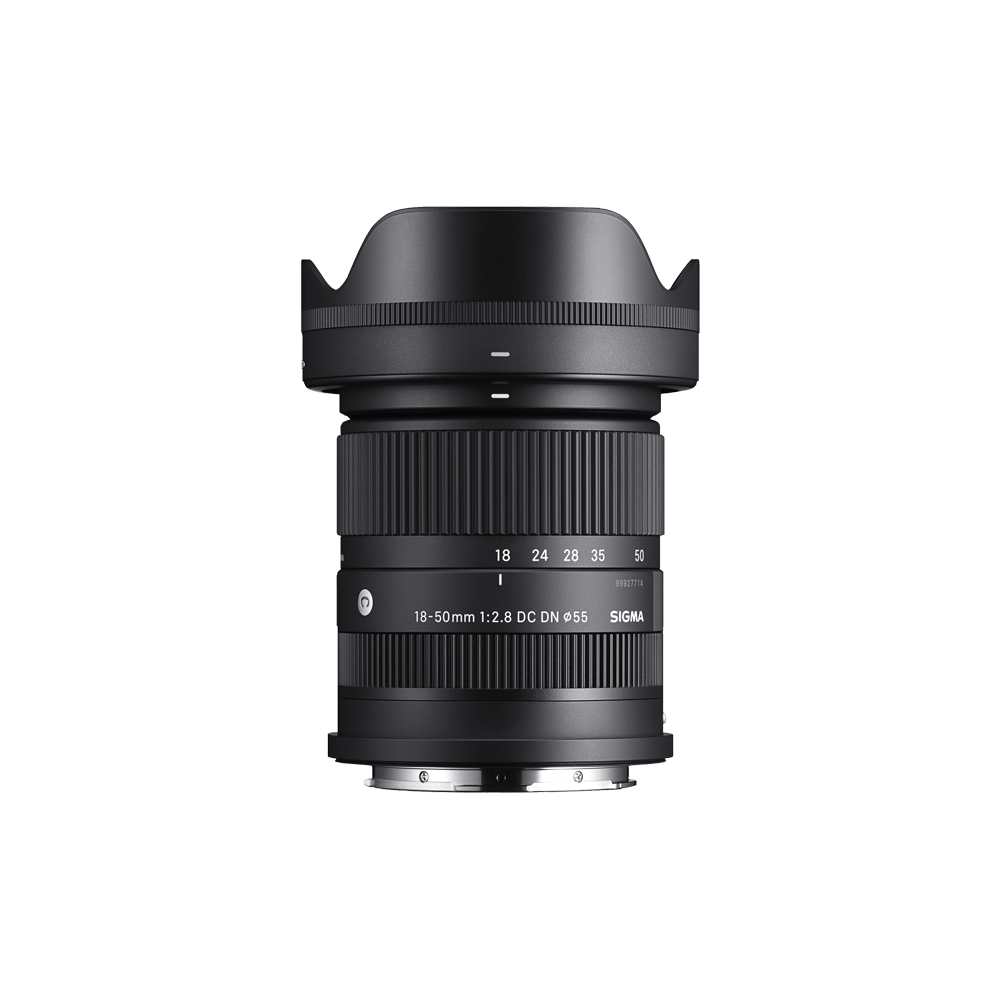
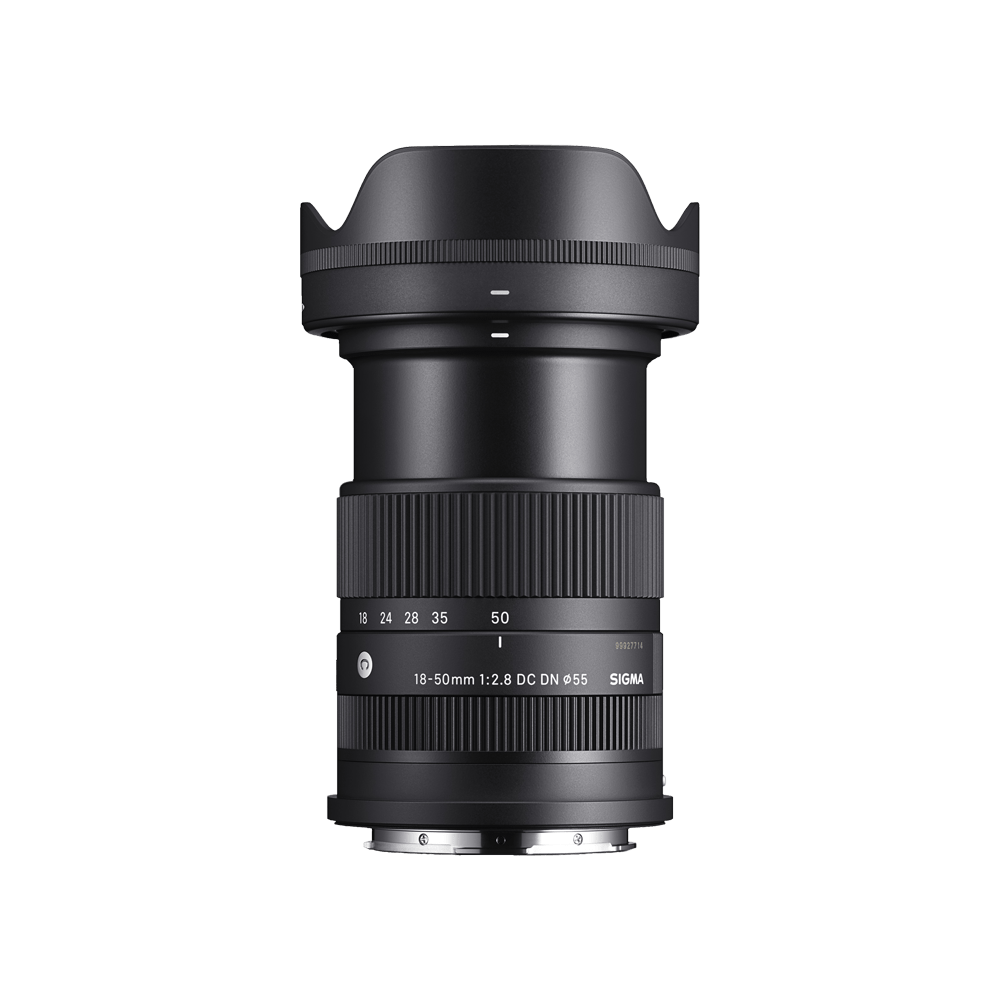
| Dimensions (Diameter × Length) | L-Mount:φ65.4mm × 74.5mm / φ2.6in. × 2.9in. * The length of a lens is measured from the filter surface to its mount. |
| Weight | L-Mount:290g / 10.2oz. |
| Edition Number | C021 The three-digit code on the surface of the lens is to indicate the year the lens was first released. |
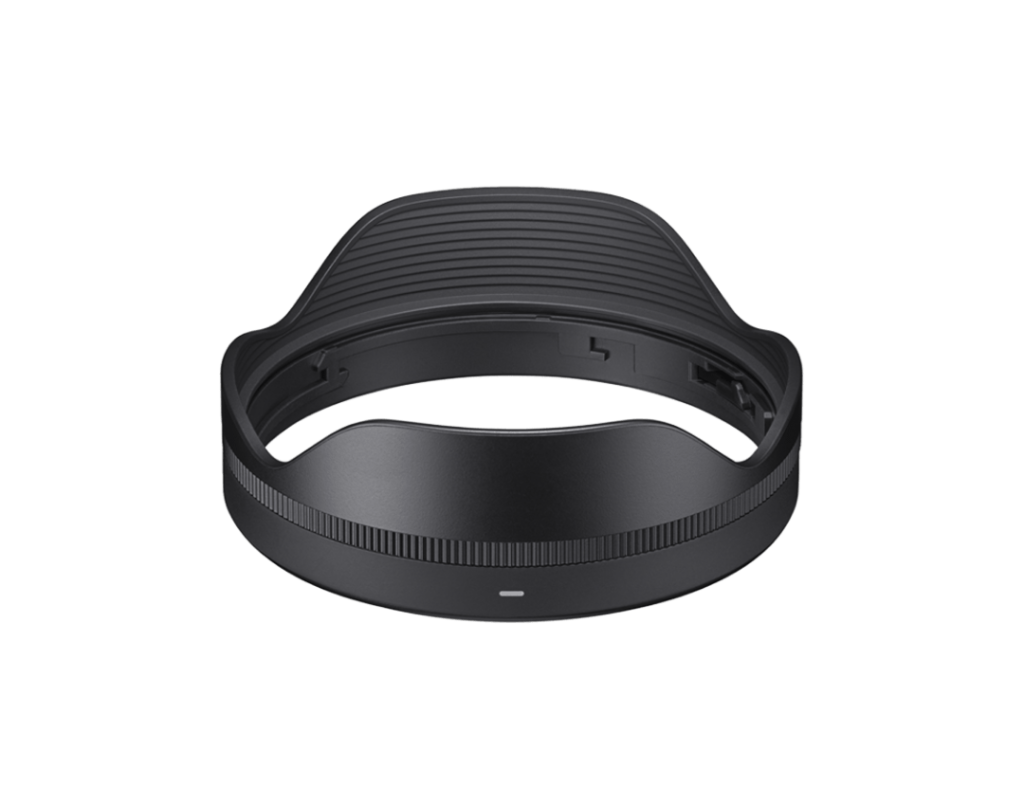
| Supplied Accessories | LENS HOOD LH582-02 |
| Mount / Product Barcode | L-Mount:00-85126-58569-3 Canon RF Mount:00-85126-58572-3 FUJIFILM X Mount:00-85126-58575-4 Sony E-mount:00-85126-58565-5 |
| Camera Compatibility | LINK |
* The appearance and specifications of the product are subject to change. |
Large F2.8 aperture and superb image quality
The Sigma 18-50mm F2.8 DC DN | Contemporary covers 27mm to 75mm in the 35mm format, and has a wide aperture of F2.8 throughout the entire zoom range. This makes it easy to achieve blurry backgrounds, which is ideal for shooting attractive portraits and close-ups. The bokeh is smooth and attractive so doesn’t distract from the in-focus subject.
The lens’s three high-precision glass-molded aspherical elements coupled with the minimization of the total number of elements yields superb optical quality without excessive weight, and the use of in-camera aberration correction further eliminates optical imperfections such as distortion and vignetting. This has all been made possible by the latest optical design technology at Sigma’s only production base in Aizu, where all Sigma lenses are built.
Exceptionally compact and lightweight body ideal for mirrorless cameras
The Sigma 18-50mm F2.8 DC DN | Contemporary is remarkably compact, matching the portability of APS-C mirrorless camera bodies. This makes it a perfect workhorse lens that is ideal for general day-to-day use. The lens is currently the smallest and lightest in its class*1, boasting a maximum diameter of φ65.4mm, a length of 74.5mm and weight of 290g*2, yet still maintains a constant aperture of F2.8.
To keep the lens as light as possible, Sigma constructed the body from carefully selected materials. A polycarbonate called Thermally Stable Composite (TSC) was used for the construction of the barrel, which is sleek, robust, and importantly has a thermal conductivity close to that of aluminum. This ensures stable performance and good operability when used in changing temperatures. By deliberately using metal for some of the internal structure, the parts could be much thinner and have a higher rigidity, ensuring the lens can stand up to frequent, heavy use.
*1 As an AF compatible, F2.8 constant aperture zoom lens for APS-C (as of October 2021, by Sigma)
*2 The values are for L-Mount.
Supports various shooting situations
The Sigma 18-50mm F2.8 DC DN | Contemporary has fast and near-silent AF that makes it perfectly suited to a range of photographic applications, including shooting in quiet environments, recording videos and capturing fast-moving subjects. This has been achieved by using a stepping motor as the AF actuator. Since it is small and lightweight, it can be used flexibly in situations such as handheld shooting, which requires high mobility, gimbal shooting, one-man operation video shooting and vlogging.
Combined with the “Pocketable Full-Frame” Sigma fp, the total weight is only 712g, and it can also be useful as a sub-lens for full-frame cameras (used in crop mode) to keep weight down. The 18-50mm F2.8 DC DN | Contemporary, which combines compactness, light weight, high performance, and large aperture, supports a variety of shooting situations, from introductory single-lens mirrorless cameras to video shooting and combination with full-frame cameras.
About the minimum focusing distance
With an emphasis on making the lens as versatile as possible in a wide variety of shooting conditions, Sigma designed the lens with a minimum focusing distance of 12.1cm and maximum magnification of 1:2.8*, making it also ideal for close-ups.
*The minimum focusing distance and maximum magnification are both values at the wide end. Remove the lens hood from the lens before use when photographing at the minimum focusing distance at the wide-angle end.
LENS CONSTRUCTION
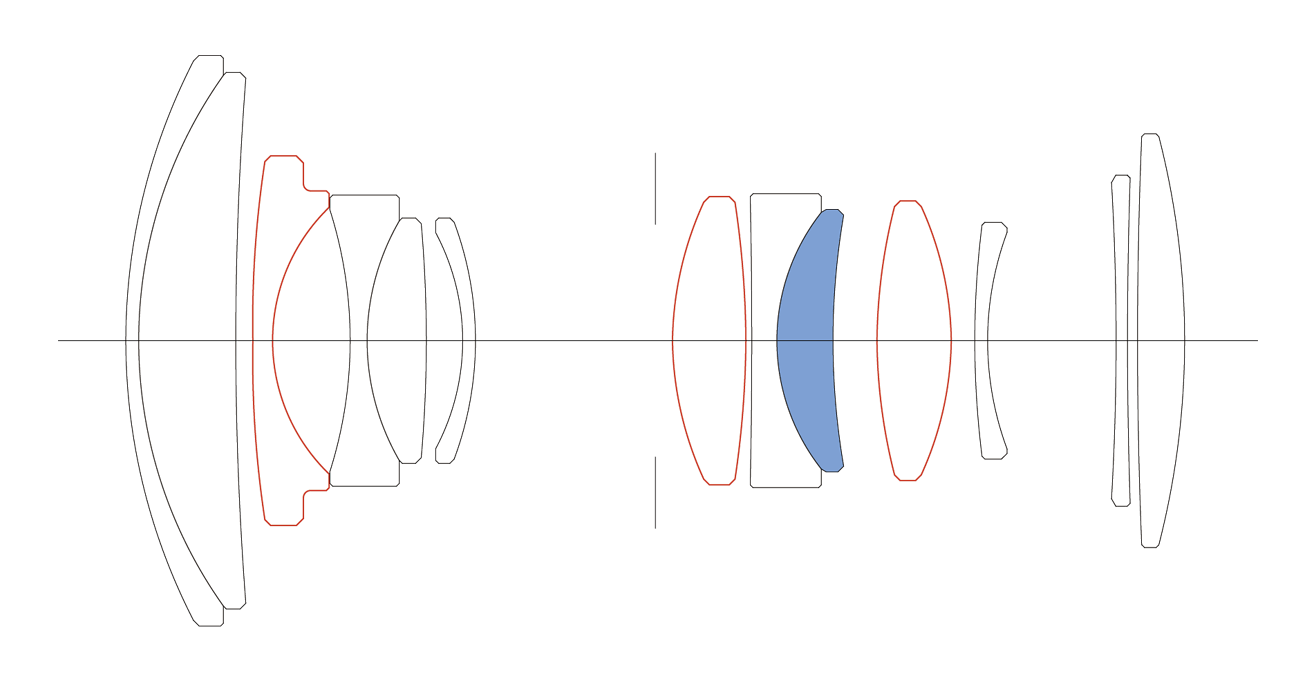

MTF Chart
DIFFRACTION MFT
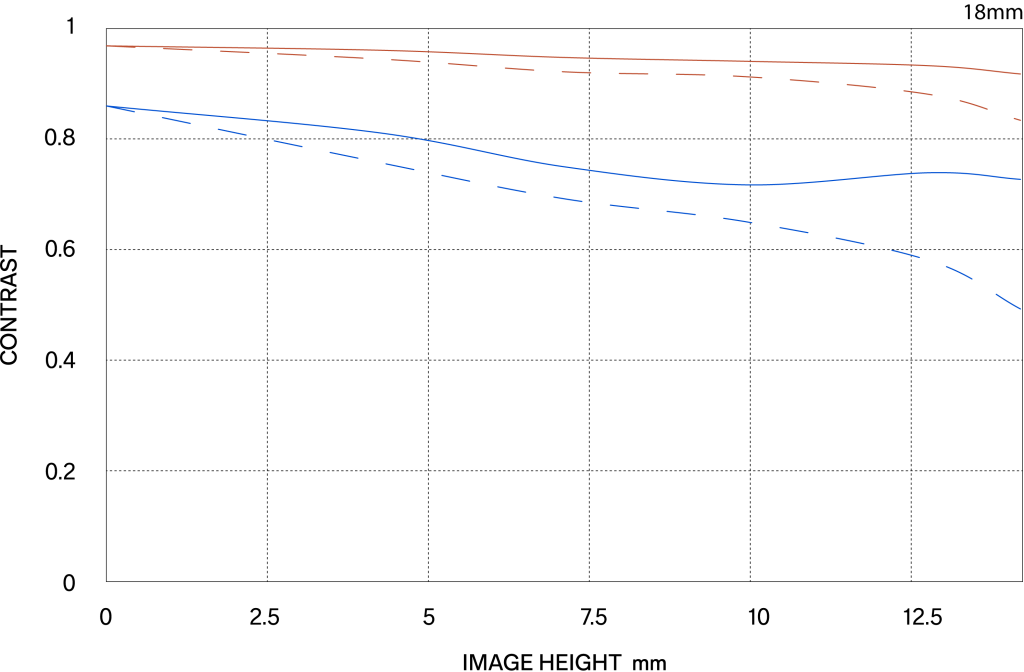
DIFFRACTION MFT
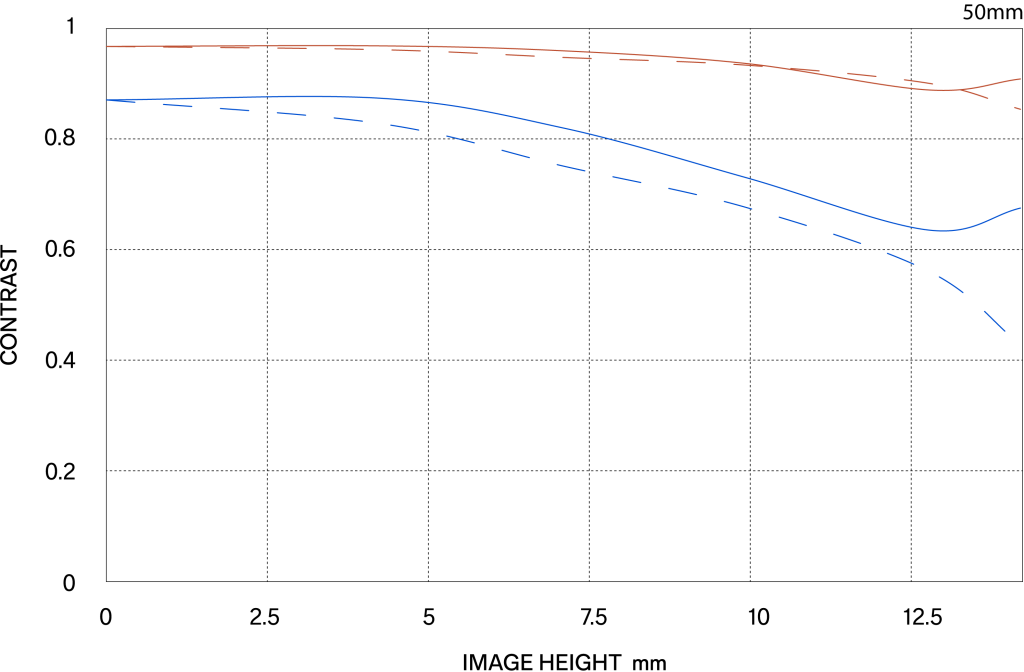
GEOMETRICAL MFT
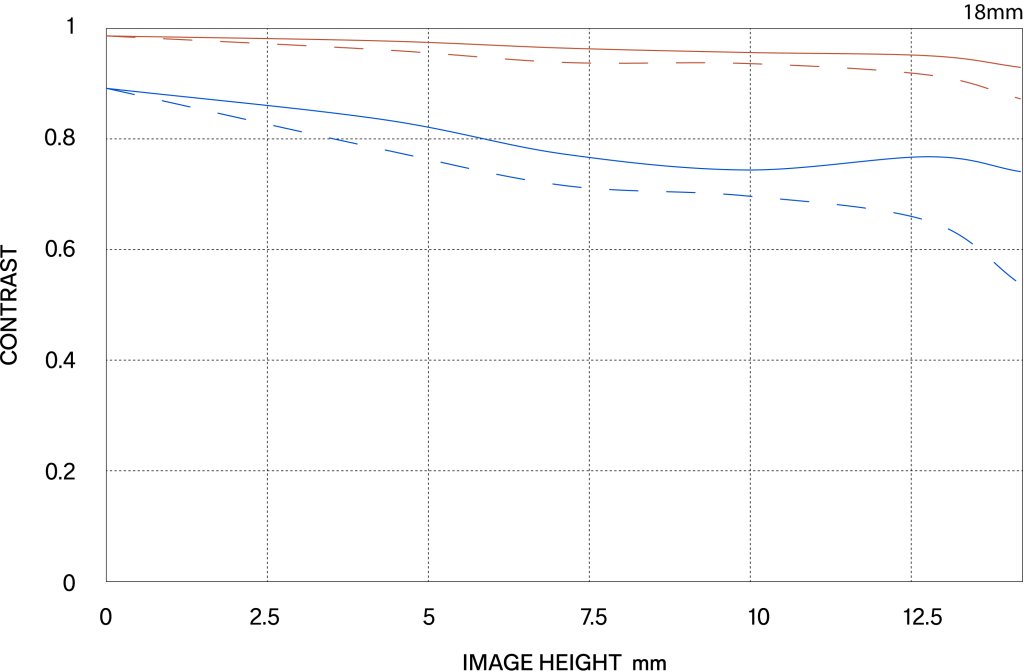
GEOMETRICAL MFT
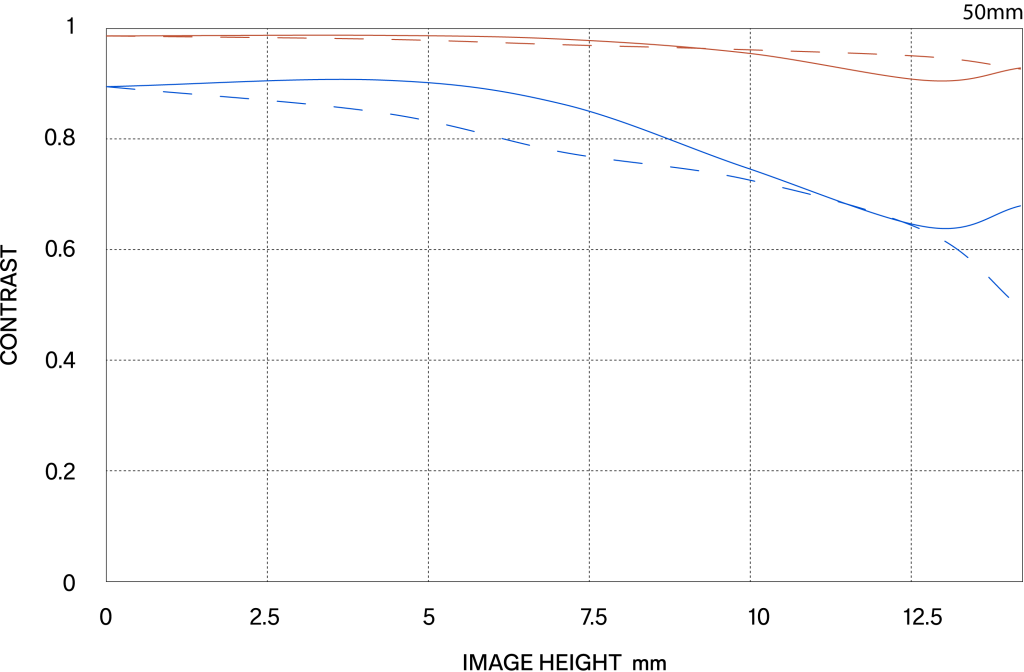

MTF CHART GUIDE
The MTF (Modulation Transfer Function) is one of the measurements for evaluating a lens’ performance, and it shows how faithfully the contrast of the subject can be reproduced on the image plane. The horizontal axis shows the image height (distance from the center of the image in mm) and the vertical axis shows the contrast value (maximum value is 1).
The closer the 10 line pairs/mm curve is to 1, the higher the contrast and clarity of the lens is, and similarly, the closer the 30 line pairs/mm curve is to 1, the better the resolution and sharpness of the lens is.
*The MTF chart depicts the result at the wide-open aperture.
*For mirrorless lenses that support distortion correction, the horizontal axis shows the image height equivalent to when an L-Mount lens is attached to a Sigma L-Mount camera with distortion correction applied. (The effect of distortion correction may differ depending on the mount and camera used.)
*The spatial frequency indicates the variation on the image plane before distortion correction is performed.
HLA is Sigma’s proprietary linear motor. It drives the focus lens directly without going through gears or other mechanical parts, resulting in quiet, high-precision autofocusing
Inner focus system
To increase stability, this lens configuration uses movable internal lens elements that adjust focus without changing the length of the lens barrel.
HLA (High-response Linear Actuator)
HLA is Sigma’s proprietary linear motor. It drives the focus lens directly without going through gears or other mechanical parts, resulting in quiet, high-precision autofocusing.
Matching the optical characteristics of the lens, this function performs in-camera corrections of peripheral illumination, chromatic aberrations, distortion, and more, to further enhance image quality.
*Function available on supported cameras only. Available corrections or auto correction functionality may vary depending on the camera model.
*On cameras where lens aberration correction is controlled with ‘ON’ or ‘OFF’ in the camera menu, please set all aberration correction functions to ‘ON'(AUTO).
Inner focus system
To increase stability, this lens configuration uses movable internal lens elements that adjust focus without changing the length of the lens barrel.
Super Multi-Layer Coating
Sigma’s own Super Multi-Layer Coating suppresses flare and ghosting by preventing reflections with in the lens. All lenses in the current Sigma range feature this original technology. In digital cameras, flare and ghosting may also be caused by reflections between the image sensor and lens surfaces. Here too, Sigma’s Super Multi-Layer Coating is highly ef fective, assuring images of outstanding contrast
Incorporates a water and oil-repellent coating that allows water to be wiped away easily and prevents oil and fat from sticking to the surface, even in challenging shooting conditions. At the same time, the maintenance of the lens surface becomes easier.
AFL button
the AFL button can be assigned with various functions widens the range of operations available on the lens.
Focus Limiter
Offers customization for the driving range of auto focus. It makes it possible to limit the drive range from a specific distance to a long distance or a short distance.
Focus Mode Switch
Using this swich, it is possible to switch the focus mode between AF and MF.
Sigma’s original OS (Optical Stabilizer) function uses sensors inside the lens to detect any motion, then moves specific lens elements in order to effectively minimize blur caused by such movement. Owing to the stabilized image in the viewfinder, it is possible to fine-tune composition and ensure accurate focusing.
Inner focus system
To increase stability, this lens configuration uses movable internal lens elements that adjust focus without changing the length of the lens barrel.
HLA (High-response Linear Actuator)
HLA is Sigma’s proprietary linear motor. It drives the focus lens directly without going through gears or other mechanical parts, resulting in quiet, high-precision autofocusing.
Matching the optical characteristics of the lens, this function performs in-camera corrections of peripheral illumination, chromatic aberrations, distortion, and more, to further enhance image quality.
*Function available on supported cameras only. Available corrections or auto correction functionality may vary depending on the camera model.
*On cameras where lens aberration correction is controlled with ‘ON’ or ‘OFF’ in the camera menu, please set all aberration correction functions to ‘ON'(AUTO).
Inner focus system
To increase stability, this lens configuration uses movable internal lens elements that adjust focus without changing the length of the lens barrel.
Super Multi-Layer Coating
Sigma’s own Super Multi-Layer Coating suppresses flare and ghosting by preventing reflections with in the lens. All lenses in the current Sigma range feature this original technology. In digital cameras, flare and ghosting may also be caused by reflections between the image sensor and lens surfaces. Here too, Sigma’s Super Multi-Layer Coating is highly ef fective, assuring images of outstanding contrast
Incorporates a water and oil-repellent coating that allows water to be wiped away easily and prevents oil and fat from sticking to the surface, even in challenging shooting conditions. At the same time, the maintenance of the lens surface becomes easier.
AFL button
the AFL button can be assigned with various functions widens the range of operations available on the lens.
Focus Limiter
Offers customization for the driving range of auto focus. It makes it possible to limit the drive range from a specific distance to a long distance or a short distance.
Focus Mode Switch
Using this swich, it is possible to switch the focus mode between AF and MF.
Sigma’s original OS (Optical Stabilizer) function uses sensors inside the lens to detect any motion, then moves specific lens elements in order to effectively minimize blur caused by such movement. Owing to the stabilized image in the viewfinder, it is possible to fine-tune composition and ensure accurate focusing.
Inner focus system
To increase stability, this lens configuration uses movable internal lens elements that adjust focus without changing the length of the lens barrel.
HLA (High-response Linear Actuator)
HLA is Sigma’s proprietary linear motor. It drives the focus lens directly without going through gears or other mechanical parts, resulting in quiet, high-precision autofocusing.
Matching the optical characteristics of the lens, this function performs in-camera corrections of peripheral illumination, chromatic aberrations, distortion, and more, to further enhance image quality.
*Function available on supported cameras only. Available corrections or auto correction functionality may vary depending on the camera model.
*On cameras where lens aberration correction is controlled with ‘ON’ or ‘OFF’ in the camera menu, please set all aberration correction functions to ‘ON'(AUTO).
Inner focus system
To increase stability, this lens configuration uses movable internal lens elements that adjust focus without changing the length of the lens barrel.
Super Multi-Layer Coating
Sigma’s own Super Multi-Layer Coating suppresses flare and ghosting by preventing reflections with in the lens. All lenses in the current Sigma range feature this original technology. In digital cameras, flare and ghosting may also be caused by reflections between the image sensor and lens surfaces. Here too, Sigma’s Super Multi-Layer Coating is highly ef fective, assuring images of outstanding contrast
Incorporates a water and oil-repellent coating that allows water to be wiped away easily and prevents oil and fat from sticking to the surface, even in challenging shooting conditions. At the same time, the maintenance of the lens surface becomes easier.
AFL button
the AFL button can be assigned with various functions widens the range of operations available on the lens.
Focus Limiter
Offers customization for the driving range of auto focus. It makes it possible to limit the drive range from a specific distance to a long distance or a short distance.
Focus Mode Switch
Using this swich, it is possible to switch the focus mode between AF and MF.
Sigma’s original OS (Optical Stabilizer) function uses sensors inside the lens to detect any motion, then moves specific lens elements in order to effectively minimize blur caused by such movement. Owing to the stabilized image in the viewfinder, it is possible to fine-tune composition and ensure accurate focusing.
Inner focus system
To increase stability, this lens configuration uses movable internal lens elements that adjust focus without changing the length of the lens barrel.
HLA (High-response Linear Actuator)
HLA is Sigma’s proprietary linear motor. It drives the focus lens directly without going through gears or other mechanical parts, resulting in quiet, high-precision autofocusing.
Matching the optical characteristics of the lens, this function performs in-camera corrections of peripheral illumination, chromatic aberrations, distortion, and more, to further enhance image quality.
*Function available on supported cameras only. Available corrections or auto correction functionality may vary depending on the camera model.
*On cameras where lens aberration correction is controlled with ‘ON’ or ‘OFF’ in the camera menu, please set all aberration correction functions to ‘ON'(AUTO).
Inner focus system
To increase stability, this lens configuration uses movable internal lens elements that adjust focus without changing the length of the lens barrel.
Super Multi-Layer Coating
Sigma’s own Super Multi-Layer Coating suppresses flare and ghosting by preventing reflections with in the lens. All lenses in the current Sigma range feature this original technology. In digital cameras, flare and ghosting may also be caused by reflections between the image sensor and lens surfaces. Here too, Sigma’s Super Multi-Layer Coating is highly ef fective, assuring images of outstanding contrast
Incorporates a water and oil-repellent coating that allows water to be wiped away easily and prevents oil and fat from sticking to the surface, even in challenging shooting conditions. At the same time, the maintenance of the lens surface becomes easier.
AFL button
the AFL button can be assigned with various functions widens the range of operations available on the lens.
Focus Limiter
Offers customization for the driving range of auto focus. It makes it possible to limit the drive range from a specific distance to a long distance or a short distance.
Focus Mode Switch
Using this swich, it is possible to switch the focus mode between AF and MF.
Sigma’s original OS (Optical Stabilizer) function uses sensors inside the lens to detect any motion, then moves specific lens elements in order to effectively minimize blur caused by such movement. Owing to the stabilized image in the viewfinder, it is possible to fine-tune composition and ensure accurate focusing.
Inner focus system
To increase stability, this lens configuration uses movable internal lens elements that adjust focus without changing the length of the lens barrel.
HLA (High-response Linear Actuator)
HLA is Sigma’s proprietary linear motor. It drives the focus lens directly without going through gears or other mechanical parts, resulting in quiet, high-precision autofocusing.
Matching the optical characteristics of the lens, this function performs in-camera corrections of peripheral illumination, chromatic aberrations, distortion, and more, to further enhance image quality.
*Function available on supported cameras only. Available corrections or auto correction functionality may vary depending on the camera model.
*On cameras where lens aberration correction is controlled with ‘ON’ or ‘OFF’ in the camera menu, please set all aberration correction functions to ‘ON'(AUTO).
Inner focus system
To increase stability, this lens configuration uses movable internal lens elements that adjust focus without changing the length of the lens barrel.
Super Multi-Layer Coating
Sigma’s own Super Multi-Layer Coating suppresses flare and ghosting by preventing reflections with in the lens. All lenses in the current Sigma range feature this original technology. In digital cameras, flare and ghosting may also be caused by reflections between the image sensor and lens surfaces. Here too, Sigma’s Super Multi-Layer Coating is highly ef fective, assuring images of outstanding contrast
Incorporates a water and oil-repellent coating that allows water to be wiped away easily and prevents oil and fat from sticking to the surface, even in challenging shooting conditions. At the same time, the maintenance of the lens surface becomes easier.
AFL button
the AFL button can be assigned with various functions widens the range of operations available on the lens.
Focus Limiter
Offers customization for the driving range of auto focus. It makes it possible to limit the drive range from a specific distance to a long distance or a short distance.
Focus Mode Switch
Using this swich, it is possible to switch the focus mode between AF and MF.
Sigma’s original OS (Optical Stabilizer) function uses sensors inside the lens to detect any motion, then moves specific lens elements in order to effectively minimize blur caused by such movement. Owing to the stabilized image in the viewfinder, it is possible to fine-tune composition and ensure accurate focusing.
Inner focus system
To increase stability, this lens configuration uses movable internal lens elements that adjust focus without changing the length of the lens barrel.
HLA (High-response Linear Actuator)
HLA is Sigma’s proprietary linear motor. It drives the focus lens directly without going through gears or other mechanical parts, resulting in quiet, high-precision autofocusing.
Matching the optical characteristics of the lens, this function performs in-camera corrections of peripheral illumination, chromatic aberrations, distortion, and more, to further enhance image quality.
*Function available on supported cameras only. Available corrections or auto correction functionality may vary depending on the camera model.
*On cameras where lens aberration correction is controlled with ‘ON’ or ‘OFF’ in the camera menu, please set all aberration correction functions to ‘ON'(AUTO).
Inner focus system
To increase stability, this lens configuration uses movable internal lens elements that adjust focus without changing the length of the lens barrel.
Super Multi-Layer Coating
Sigma’s own Super Multi-Layer Coating suppresses flare and ghosting by preventing reflections with in the lens. All lenses in the current Sigma range feature this original technology. In digital cameras, flare and ghosting may also be caused by reflections between the image sensor and lens surfaces. Here too, Sigma’s Super Multi-Layer Coating is highly ef fective, assuring images of outstanding contrast
Incorporates a water and oil-repellent coating that allows water to be wiped away easily and prevents oil and fat from sticking to the surface, even in challenging shooting conditions. At the same time, the maintenance of the lens surface becomes easier.
AFL button
the AFL button can be assigned with various functions widens the range of operations available on the lens.
Focus Limiter
Offers customization for the driving range of auto focus. It makes it possible to limit the drive range from a specific distance to a long distance or a short distance.
Focus Mode Switch
Using this swich, it is possible to switch the focus mode between AF and MF.

| Camera | SONY α6600 |
|---|---|
| Shutter Speed | 1/500s |
| Lens F Number | F4 |
| ISO | 100 |
| Focal Length | 50mm |
| Photographer | Damien Dohmen |

| Camera | SIGMA fp L |
|---|---|
| Shutter Speed | 1/1250s |
| Lens F Number | F2.8 |
| ISO | 100 |
| Focal Length | 18mm |
| Photographer | Aya Iwasaki |

| Camera | SONY α6500 |
|---|---|
| Shutter Speed | 1/200s |
| Lens F Number | F2.8 |
| ISO | 250 |
| Focal Length | 28.4mm |
| Photographer | Hsu Wu Te |

| Camera | Canon EOS R |
|---|---|
| Shutter Speed | 1/320s |
| Lens F Number | F2.8 |
| ISO | 100 |
| Focal Length | 18mm (28.8mm in the 35mm format) |
| Photographer | Etsuko Aimu |
IMPRESSION What a perfect little lens. My constant travel companion. CONTEMPORARY 18-50mm F2.8 DC DN by Jim Koepnick Traveling to a major city is my type of vacation, giving me…
READ MORE
IMPRESSION The versatile zoom lens for everyday adventures. CONTEMPORARY 18-50mm F2.8 DC DN by Damien Dohmen As a professional photographer, I need to use flagship and professional level equipment. However,…
READ MORE
IMPRESSION Discover ever-changing joy in this seemingly ordinary world. CONTEMPORARY 18-50mm F2.8 DC DN by Hsu Wu Te The gates to the Underworld opens in the 7th month of the…
READ MORE